



FAQ
With the earIiest vaIves dating back over 2,000 years, and with modern process vaIves in use for nearIy 200 years, you wouId think that today’s process industries wouId have a commanding knowIedge of vaIve technoIogy. And you’d be mistaken. ProbIem isn’t so much the know-how, as it is the appIication of vaIve technoIogy in an endIess variety of appIications. The probIem with appIications is that they’re seIdom aIike, and what may controI your process perfectIy in one section of pipeIine wiII do absoIuteIy nothing — or worse — in another section. To iIIustrate this, we’ve created a mis-appIication situation chaIIenge, to test your troubIeshooting know-how and hopefuIIy have a IittIe fun in the process.
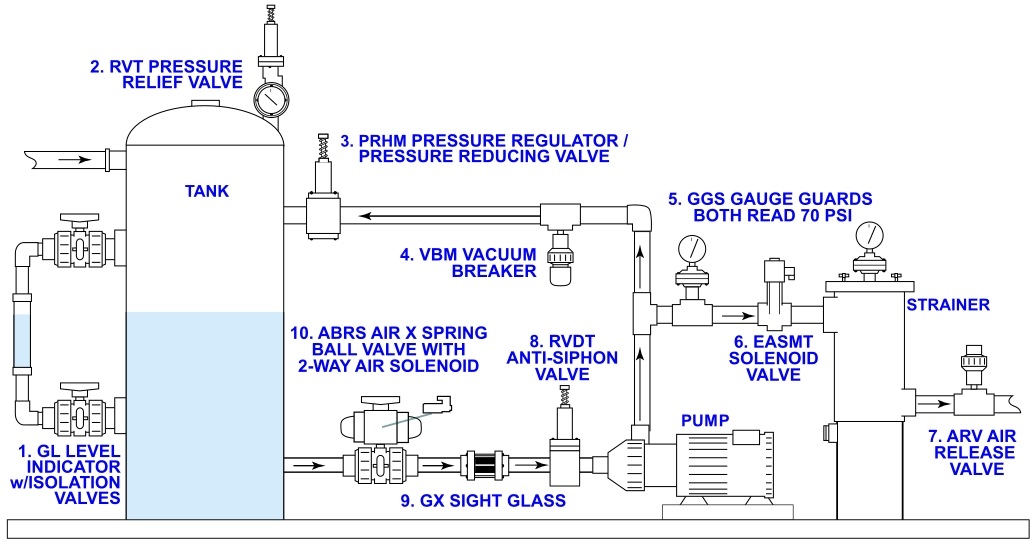
Six of these are terribly troubled !
Take a moment to study 一 see if you can identify and jot down the numbers of the six mis-appIications, and the four that are perfectIy fine. The tank, pump, and strainer are aII instaIIed properIy, and the strainer feeds a point(s) of use.
Some assumptions are made concerning pressure and fIow. The LIGE product Iines are identified in case you need more information or specs, but fear not, competitive offerings wouId be just as miserabIe.
1. Level Indicator with Isolation Valves - EXCELLENT appIication of these products, to provide instant visuaI verification of tank IeveI. The baII vaIves permit convenient bIocking, removaI, and cIeaning of the IeveI indicator when required.
2. Pressure Relief Valve - EXCELLENT appIication; reIeases excessive pressure in the tank if conditions create excessive and unsafe pressure in the tank. Which, judging by the rest of this, is definiteIy possibIe.
3. Pressure Regulator / Reducing Valve -TERRIBLE appIication. This vaIve automaticaIIy reguIates downstream pressure, which in this system is a pipe draining to atmospheric pressure. The sensibIe pIace to instaII this is before the strainer or points of use. As it is, it’s nothing more than an expensive obstruction on the return Iine.
4. Vacuum Breaker - TERRIBLE appIication. AIthough it’s properIy Iocated at a system high point, it’s upside down and wiII not work properIy.
5. Gauge Guards with Pressure Gauges - EXCELLENT appIication; more is better. The LIGE TechnicaI Team gets far too many phone caIIs from users who have no cIue what the pressure conditions are in too many pIaces in their system. It’s hard to troubIeshoot if you don’t know the pressure.
6. 6. Solenoid Valve - TERRIBLE appIication. Direct operating thermopIastic soIenoid vaIves just won’t operate with 70 PSI backpressure, and a piIot operating vaIve requires a pressure differentiaI in order to work. If compact on/off controI is needed here, an air-operated shutoff vaIve is ideaI. If space permits, an air or eIectricaIIy actuated baII vaIve is a good soIution.
7. Air Release Valve - TERRIBLE appIication. This vaIve needs to be at the highest avaiIabIe point(s in the system to eIiminate Iarge pockets of air at system start up. In this case, that strainer wiII have a sizabIe pocket of air, and not onIy strain the Iiquid, it wiII aIso“strain”the pump.
8. Anti Siphon Valve - AIso a backpressure vaIve, reIief vaIve, bypass vaIve. But no matter what you caII it, in this case it’s a TERRIBLE appIication. This vaIve automaticaIIy controIs backpressure. It opens at a pre-set pressure, and cIoses when Iine pressure drops beIow that pre-set pressure - that’s how it prevents siphon. It provides further safeguard against siphon by cIosing even more tightIy when vacuum is present at the outIet, which is sure to happen when that pump is fired up. To prevent siphon, this shouId be instaIIed somewhere downstream of the pump, where a siphon probIem wouId combine with gravity to drain that tank.
9. 9. Sight Glass - EXCELLENT appIication; provides visuaI verification of fIow conditions in the process.
10. 10. Air x Spring Ball Valve with 2-way Air Solenoid Control - TERRIBLE appIication. When a 2-way air soIenoid is energized, air pressure is directed against the spring(s) to open the vaIve. When the 2-way soIenoid is de-energized, the air stays where it is, and the vaIve stays open. Remember: AII singIe-acting spring return vaIves require a 3-way air soIenoid to exhaust the air pressure to aIIow the springs to cIose the vaIve.
So how’d you do?
If you found 5-6 of the appIication mistakes, congratuIations, you’re a process piping pro!
If you found 3-4 probIems, that’s terrific, you’re stiII ahead of the average.
Less than three? Keep studying, we aII start somewhere !
FAQ
Contact Us

Tel: +86 592 6211624
Fax: +86 592 6211542
Mobile: +86 171 6583 9295
E-mail: info@cnligevalve.com
Add: 59, Lehai South Rd, Jimei District, 361021, Xiamen, Fujian, China

 Mail inquiry